How to Get Rid of Mice in the House: NYC Homeowner Guide
On This Page
If you just spotted a mouse darting under your kitchen stove, your first question is probably simple: how do you get rid of mice in the house without losing your mind? For homeowners and renters in New York City and Westchester, spotting droppings, hearing scratching in walls, or finding gnaw marks means it is time to act. Mice are more than a nuisance. They can spread disease through droppings, urine, and saliva, and they can trigger asthma and allergies indoors. Acting early is easier than waiting for an established infestation.
In this guide, you will learn how to confirm mice indoors, tell mice and rats apart, understand who handles the problem in NYC rental buildings, and work through practical steps like sealing entry points, removing food and water, clearing nesting sites, and setting traps. We will also cover when DIY stops being enough and what a professional mouse inspection and treatment looks like. Rye Pest Solutions is a family-owned local team with certified technicians and MBE certification, ready to help with inspection, removal, and prevention across NYC and Westchester. Let’s start with your next step.
Why Mice in the House Are Worth Acting On Now
Mice in a home are a health concern, not just a nuisance, and acting early usually means less work. The NACCHO/CDC rodent control compendium notes rodents can spread disease directly through feces, urine, or saliva, and indirectly through ticks, mites, or fleas. It lists hantavirus, leptospirosis, rat bite fever, and murine typhus among U.S. rodent-borne diseases and links rodents to asthma and indoor allergies. In NYC apartments, shared walls and pipes mean that risk rarely stays in one unit.
Guidance agrees rodents are easier to control before they establish themselves, and routine checks for droppings and gnaw marks catch activity earlier than waiting to see a mouse. Which mouse you are seeing also changes the plan.
Local rules decide who does the work. NYC codes require owners to keep tenant homes free of pests, and the Health Department says owners must keep rats out.
How to Confirm You Have Mice Indoors
Signs usually show up before the mouse does. In our experience, droppings are the clearest evidence: small, dark, pointed, and about the size of a grain of rice. Check along baseboards, in cabinets and drawers, behind the stove and refrigerator, and under sinks. Newer droppings tend to look darker and glossier, while older ones dry out and fade.
Gnaw marks appear on food packaging, baseboard corners, soap, candles, plastic containers, and wiring. Shredded paper or fabric piled nearby means a mouse is bedding down close by.
Field work adds clues. Quiet scratching or scurrying in ceilings or wall voids often points to rodents moving after dark, and dark rub marks along walls, pipes, and cabinet edges trace repeated routes.
Nests hide behind appliances, in storage boxes, or deep in closets. Pets sometimes pick up sounds people miss. For a no-touch check, dust a suspected run and look for tracks in the morning. If signs point to an active infestation, professional rodent control is the next step.
Mice or Rats? Why the Difference Matters in NYC
Droppings and gnaw marks confirm a rodent, but not which one. The NACCHO/CDC rodent compendium names house mice, Norway rats, and roof rats as the main U.S. rodent pests, and they behave differently indoors.
Mice tend to nest and urinate in one spot, so activity concentrates in a single kitchen, pantry, or apartment, while rats roam and dribble urine as they go, which makes them a building-wide problem more often than a one-unit one.
Mice also flatten through openings as small as a quarter inch, while rats chew to enlarge theirs; NYC Health Department rat guidance focuses on foundation cracks and gaps under doors, spots that matter for mice too. That explains why exclusion beats traps in older NYC buildings.
Reporting differs: NYC 311 rodent complaints routes mice inside an apartment or a public area to HPD, and rats inside a residential property to the NYC Health Department.
Identify the rodent first: it decides which agency you contact, whether you treat one unit or the whole building, and what a technician inspects.
Renters and Homeowners: Who Handles the Problem in NYC
NYC housing and health codes require property owners to keep tenant homes free of pests, including mice, rats, and roaches. That duty sits with the owner.
Renters should report the problem in writing to the landlord or management company, keep dated photos, and make the unit available for treatment.
If the landlord does not respond, escalate. Mice inside an apartment or public area go to HPD, which you can reach by filing a complaint through NYC 311.
Cockroach sightings work the same way, so know water bugs from cockroaches before filing.
If you own, exclusion, sanitation, and treatment are yours, including shared walls, basements, and common areas. Landlords should plan a whole-building inspection, since one unit rarely shows what is behind the walls.
Westchester changes the route: those agencies cover New York City addresses, so suburban homeowners there work with their own municipality and a pest control provider, and often have more entry points to watch around foundations, garages, basements, and additions.
Step 1: Seal the Entry Points Mice Are Using
Whoever handles the problem, the first fix is the same. Walk the home with a flashlight, inside and out, noting every gap: door sweeps and thresholds, pipe and cable penetrations, dryer and exhaust vents, foundation cracks, and where siding, brick, or trim meets the frame. NYC Health Department prevention guidance covers this: seal foundation cracks and gaps under doors, keep trash in rat-resistant containers with tight lids, trim low shrubs, and keep tall weeds down.
Match the material to the opening. The usual approach is packing gaps with copper wool or galvanized hardware cloth before sealing, since expanding foam alone gives mice something to chew and nest in. Interior gaps matter too in NYC buildings: behind baseboards, under kitchen cabinets, around radiator and sink pipes, and openings between units. Sealing a pre-war apartment room by room covers them.
Seal what you can, note the date, and recheck the spot for fresh droppings. Mice shift to the next easy route, so a second pass is normal. When gaps keep turning up, professional exclusion work is worth it.

Step 2: Remove Food and Water Sources
With entry points sealed, cut off what draws mice back inside. Move cereal, pasta, rice, flour, crackers, and pet food into hard plastic or glass containers with tight lids. Bags, boxes, and chip clips will not stop a mouse, and pet food is a common food source indoors.
Clean nightly where mice actually travel: counters, the stovetop, under and behind appliances, inside the toaster, and the floor around the trash can. Mice need very little to keep going, so stray crumbs are worth clearing.
Water matters too. Fix dripping faucets, slow drains, and leaking pipes under sinks, and empty standing water from saucers indoors. Take trash out daily in containers with tight lids, and rinse recycling that held food or drink. NYC Health Department prevention guidance centers on removing food and shelter, which is why sanitation and sealing come before bait. City guidance favors non-chemical methods, and pesticides should not be the only tool. See how mice behave indoors.
Step 3: Clear Nesting Sites and Clutter
Clutter comes next, and it is the easiest task to put off. Paper, old fabric, insulation, and cardboard are ideal bedding, so swap cardboard storage for sealed plastic bins in basements, closets, garages, and storage rooms. Then move boxes and shelving off the walls in each room. You remove a hiding spot and can spot droppings and trails without moving furniture.
Outside, shelter leads straight to your foundation, so trim low shrubs and keep tall weeds down to strip the cover mice use to reach the house.
Moisture and clutter go together indoors. Leaks under sinks, around dishwashers, and near water heaters create the warm, damp conditions mice prefer, and paper or clothing piled nearby becomes an instant nest.
Do not clear everything at once. Work one room or zone per weekend, starting with the kitchen, basement, and attached garage. If that feels like one chore too many, preventative maintenance programs keep it on a schedule.
Step 4: Set Traps and Check Them Every Day
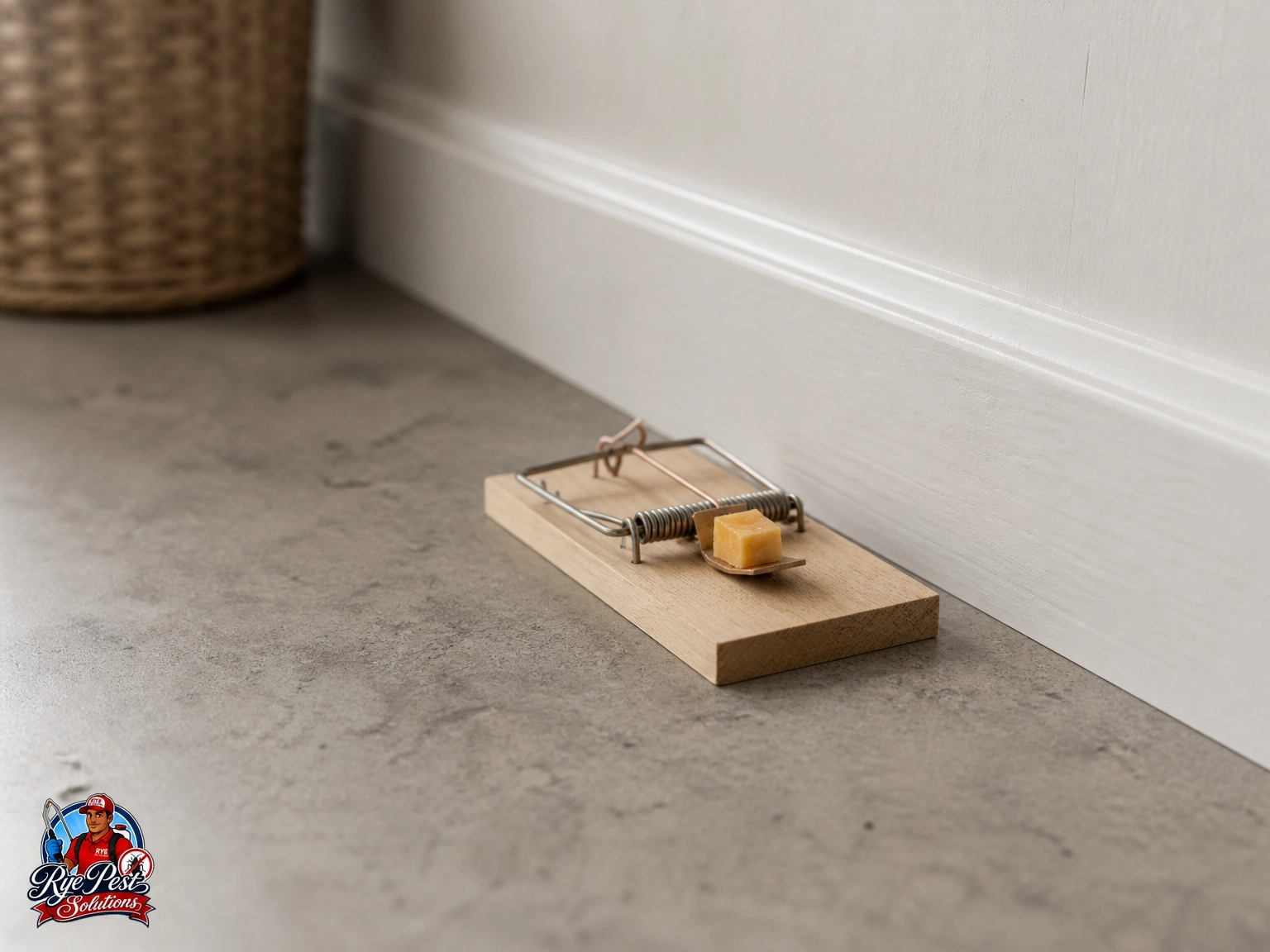
With nesting sites cleared, trapping is the next move. Snap traps are the standard non-chemical option, and NYC guidance favors trying non-chemical methods before pesticides.
Placement does the work. Set each trap along a wall rather than in the middle of the floor, following the run mice travel, and put traps where you have found droppings, gnaw marks, or grease trails.
Bait lightly with peanut butter or a bit of dried fruit, and wear gloves when handling traps or droppings. Check daily. An uncollected mouse is easy to forget and easy to smell, so a regular round matters.
Keep traps out of reach of children and pets, never where a dog or cat can drag them. If chemical tools seem necessary, follow the label or let a licensed professional decide.
Give it a fair window before you judge the results. If activity continues, that is your signal to move on.
When DIY Stops Being Enough
Two weeks of consistent trapping with sealed entry points is a reasonable checkpoint, not a rule. No agency publishes a firm threshold for calling a professional, so this comes down to judgment.
If activity continues past that point, a mouse is likely using a route or food source you have not found. Broader patterns matter too: signs in several rooms, activity on more than one floor, a problem that returns every fall and winter, or neighbors seeing mice as well. All suggest work beyond one apartment.
Households with young children or pets, or someone with asthma, often need traps and baits handled differently, which is a common reason to let a licensed professional make the call.
Renters have a second path: written notice to the landlord, then HPD or NYC 311 if the building does not respond. An inspection also documents conditions in the unit. For a sense of how DIY and professional pricing compare, see our breakdown of bed bug treatment costs in the Bronx.
What a Professional Mouse Inspection and Treatment Looks Like
Once an inspection makes sense, here is what happens. A certified technician starts by inspecting, not treating: entry points, travel routes, nesting sites, food and water sources, plus adjoining units, basements, or common areas when relevant. Treatment follows those findings. That might mean trapping, exclusion work around entry points, and removal, with non-chemical methods considered before chemical ones. Plans are built around your property, not a template.
Prevention and monitoring close the loop. Plans typically include a follow-up visit and practical recommendations on sealing, storage, and sanitation.
This is where Rye Pest Solutions fits. We are a family-owned, MBE-certified pest control company serving all five NYC boroughs and Westchester County, recognized as Best Pest Control in the Bronx for multiple consecutive years. Our certified technicians work with homeowners, tenants, landlords, and property managers. A family-owned team working the same boroughs weekly can plan around what your building actually needs.
Schedule an inspection with Rye to confirm what is happening and stop it.
How to Keep Mice From Coming Back
Prevention works best on a schedule. Walk the exterior on a schedule, since door sweeps wear out, vents work loose, and utility openings reopen after repair work. Sanitation is prevention, not a one-time project. Maintain the perimeter year round by trimming low shrubs, keeping tall weeds down, and storing nothing against the foundation. That matches NYC Health Department guidance and removes the cover mice use to approach. Once a month, check the spots that showed activity before, including baseboards, cabinets, and the basement, for fresh droppings or gnaw marks. The CDC's advice to check regularly is exactly that habit, and it catches a new problem while it is small. If monitoring does not fit your schedule, preventative maintenance programs keep inspection and treatment on a recurring plan. Westchester homeowners with attached garages, basements, or additions often have more entry points to watch.
Your Next Step If You Have Mice Right Now
If a mouse turns up anyway, you do not need to start from scratch. The CDC's reasoning is simple. Rodents are easier to control before they establish themselves, so acting on droppings and gnaw marks beats waiting to actually see one.
If signs show up in several rooms, or you still cannot find the entry point, an inspection is the sensible next move rather than repeating the same steps.
Rye Pest Solutions handles inspection, treatment, removal, and prevention across all five NYC boroughs and Westchester County. Call the team to book an inspection.
Conclusion
Mice in a New York City home are a manageable problem when you act early and follow a clear sequence. Give DIY sealing and trapping about two weeks. If activity continues, spreads to multiple rooms, or you cannot find the entry point, professional help is the smarter next step. Ongoing monitoring still matters, since fresh droppings or gnaw marks near baseboards, cabinets, and basements can reveal a new issue before it grows. If you have mice right now, call Rye Pest Solutions to schedule an inspection and take the first step toward a more comfortable home.